
Optional equipment
Add-ons that change how your line runs. Options are built in at our factory, so choose them with your machine order. Ask an engineer which ones fit your job.
Lateral pallet exchange system
Swap a full pile for an empty pallet sideways, with the next pallet already waiting under the operator walkway.
- Full pile leaves to the drive side on transfer chains
- Next steel plate and empty pallet move in from under the walkway
- Empty pallet returns under the running pile
Available on TKSC, TNSC, TW, GTM.
The 3D view needs WebGL, which this browser has turned off.
How it works
In the layboy the pallet sits on a steel plate that lowers as the pile grows. When the pile is full, the sheeter pauses: the plate lowers onto transfer chains, which carry the full pile out to the drive side while a prepared steel plate and empty pallet move in from their ready position under the operator walkway and lift to stacking height. At the drive side the full pile is taken away, a new empty pallet goes onto the plate, and the chains return it under the running pile to the ready position under the operator walkway.
Cut-to-register (RGT)
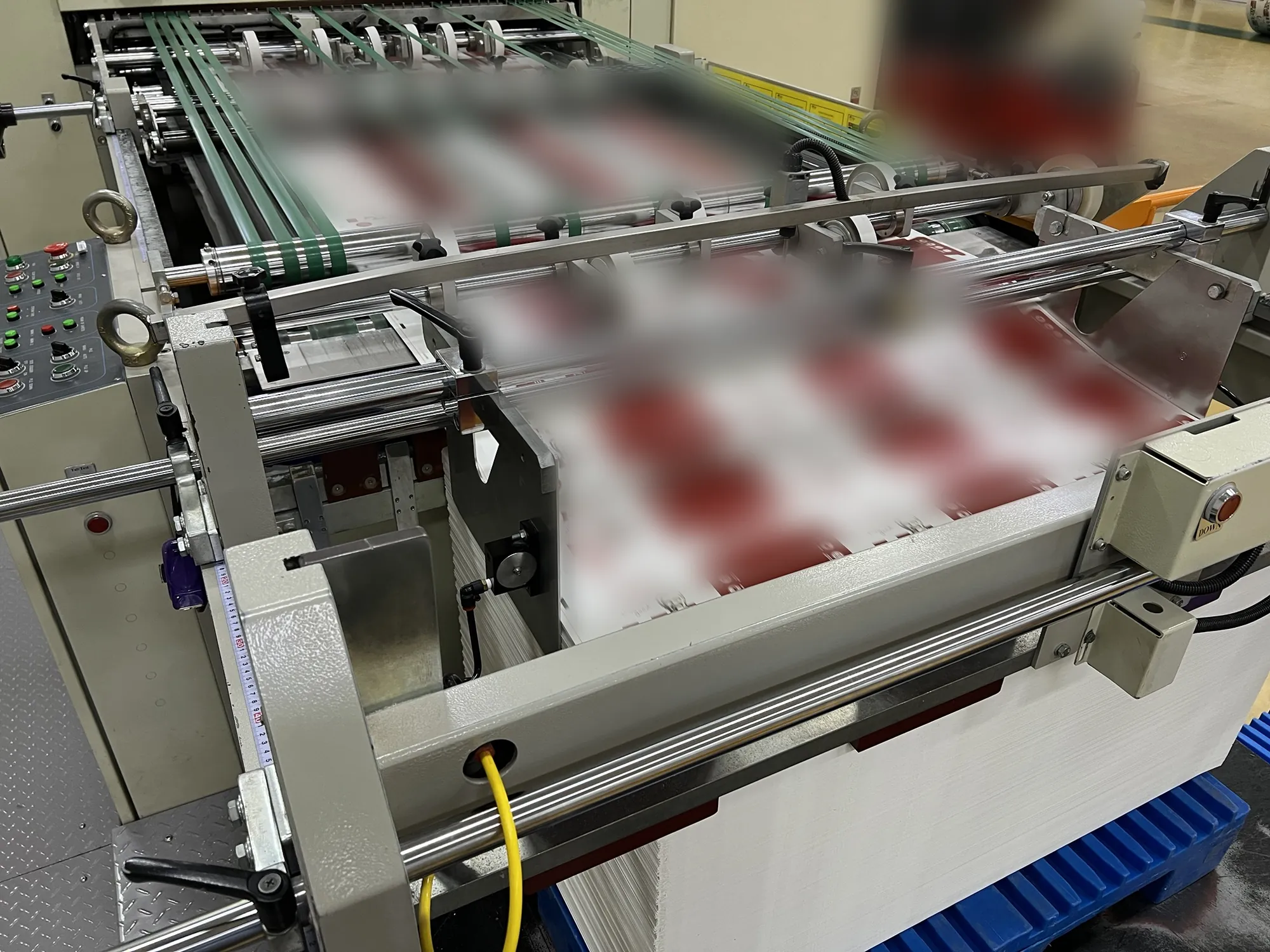
Cuts pre-printed rolls on the print mark, so the print lands in the same place on every sheet.
- ±0.3 mm cut-to-register accuracy
- Up to 300 m/min
- For beer labels, paper-cup stock and printed packaging
Available on TKSC, TW, GTM, CSZ.
Cut on the mark · ±0.3 mm
The 3D view needs WebGL, which this browser has turned off.
How it works · video
For pre-printed rolls and films, RGT cuts on the print mark so every sheet lands on register. Suited to large runs of beer labels, paper-cup stock and other printed work.
Inline defect inspection and reject system
Finds defects across the full web width and rejects those sheets automatically, so only good sheets reach the pile.
- Full web width, checked while the line runs
- Defective sheets tipped into a reject bin after the cut
- Defect record with images for every run; data stays on your premises
Available on all Golden Tec sheeters (TKSC, TNSC, TW, GTM, CSZ).
The 3D view needs WebGL, which this browser has turned off.
How it works · video
Checks the full web width while the line runs, finds and classifies surface defects automatically, and rejects the affected sheets after the cut, so only good sheets reach the pile. Operators see each defect on screen as it happens, and every run keeps a defect record with images for your quality reports. Inspection data stays on your premises.
Inline embossing
A continuous embossing unit between the unwind and the slitting station, so sheets leave the line already embossed.
- Embossing width up to 1,000 mm (39")
- Up to 100 m/min (330 ft/min); speed depends on material and thickness
- Combines with cut-to-register, inline inspection and lateral pallet exchange
Available on TKSC, TNSC, TW, CSZ.
How it works · video
The embossing unit sits between the unwind and the slitting station. The web runs continuously through the embossing rollers and straight on to slitting and cutting, so no separate embossing pass is needed. Working width is up to 1,000 mm (39"). Maximum speed is 100 m/min (330 ft/min); the actual speed depends on the material and its thickness. Inline embossing can be combined with cut-to-register (RGT), the inline defect inspection and reject system, and the lateral pallet exchange system.
An engineer replies within one working day (GMT+8).